September 2026
Friday
Societal resilience is not a cost — it is an investment, a market and the future
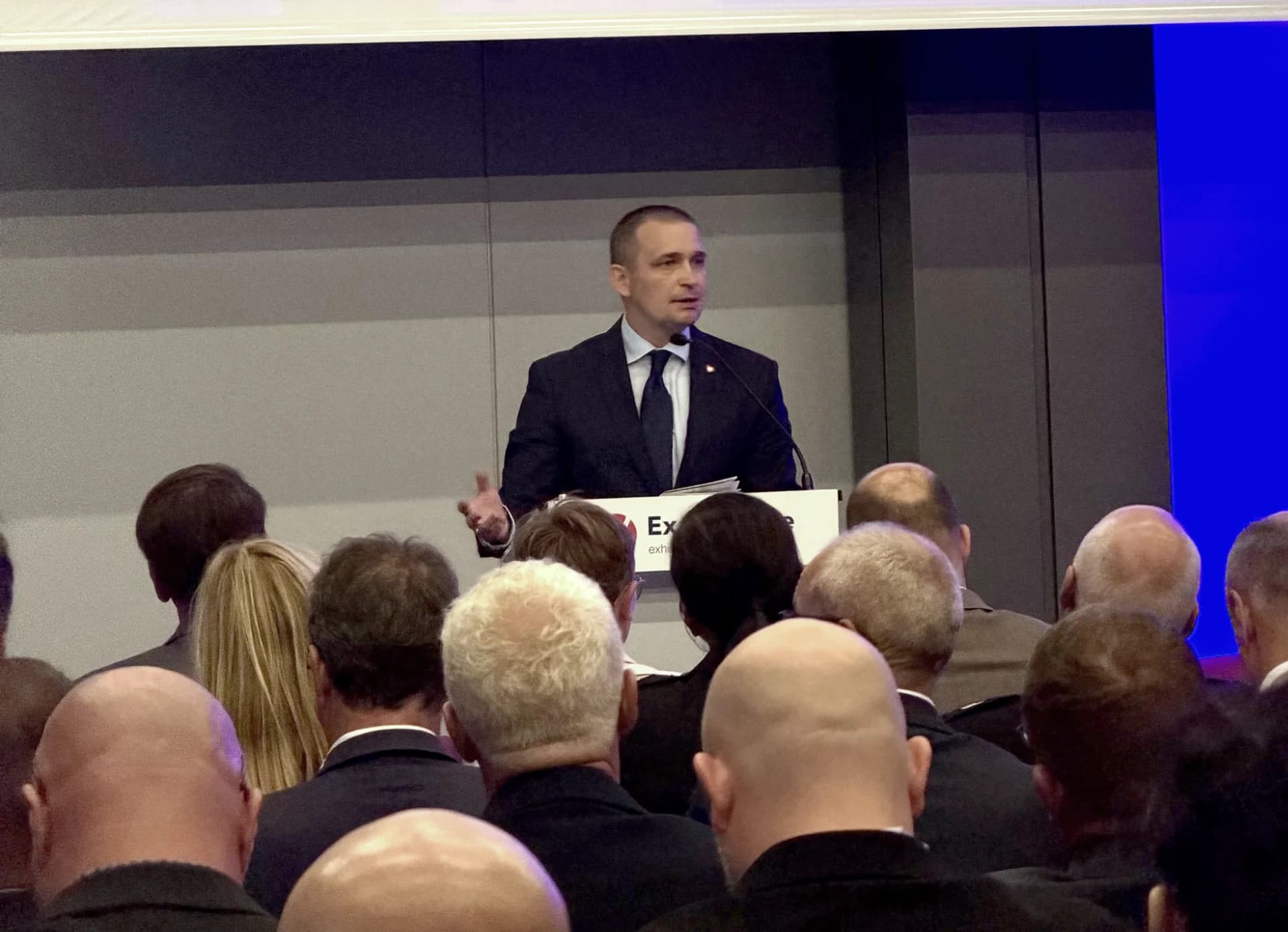
On 10 September 2026 ICCSS, in cooperation with Targi Kielce, held the 1st International Resilience Leaders Forum. For the first time in the history of MSPO, central and local government, emergency services, the armed forces, critical infrastructure, civil society, academia and business sat down at one table.
Societal resilience is not a cost — it is an investment, a market and the future
On 10 September 2026 the International Centre for Civil and Societal Security (ICCSS), in cooperation with Targi Kielce, held the 1st International Resilience Leaders Forum. For the first time in the history of the International Defence Industry Exhibition (MSPO), representatives of central government, local government at every level, emergency services, the armed forces, critical infrastructure operators, civil society organisations, academia and business sat down at one table.
From Piaseczno to Kielce
The Forum was not a stand-alone event. It was the next stage of the process “Together We Implement Societal Resilience”, which began on 5 June 2025 in Piaseczno, at the 1st National Local Government Forum on Civil Protection and Societal Resilience, where more than 400 participants — mayors, village leaders (sołtysi), firefighters, industry, civil society organisations and representatives of central government — launched a network of societal resilience partners: from the village leader to the minister.
Over the following year that network grew by several hundred people, and ICCSS together with its partners, including the Association of Rural Municipalities, launched the first projects: Societal Resilience Municipality, Social Resilience Clubs (KOS), the STRAŻNIK risk assessment system, the “Bądź Gotów” (Be Ready) app, the CYBRELIA cybersecurity exercises and the international research network SERN, together with a series of webinars.
The Forum in Kielce was the moment when this process moved up to the level of resilience leaders.
Plenary session — what the state is doing
Min. Michał Jaros (State Secretary, Ministry of Development and Technology) spoke about the societal resilience market and the Democratic Supply Chain. Zbigniew Muszyński (Director of the Government Security Centre, RCB) presented the new crisis management regulations, the protection of critical infrastructure and supply chain security — including what is changing in the plans of municipalities, counties and voivodeships. Jan Rajchel (President of the Government Agency for Strategic Reserves, RARS) spoke about strategic reserves and models of contracting with the private sector. Jarosław Margielski (Mayor of the City of Otwock, adviser to the President of the Republic of Poland) presented local community preparedness from the perspective of a city that successfully handled a major water supply failure. Michał Braun (Director of the National Freedom Institute) presented the role of civil society organisations and volunteering as partners in the civil protection system.
Three panels — three leading questions for the process
Panel 1 — where the boundary of responsibility runs
The panel “Societal resilience — from whole-of-government responsibility to whole-of-society engagement” was chaired by Wojciech Dzięgiel (Casimir Pulaski Foundation). The discussion moved through the five tiers of the resilience cascade — law, money, region, municipality and citizen — represented in turn by Robert Klonowski (Ministry of Interior), Michał Kopeć (Bank Gospodarstwa Krajowego), Col. (ret.) Jerzy Flis (Marshal’s Office of the Lublin Voivodeship), Wojciech Marszał (Association of Rural Municipalities, more than 650 municipalities) and Ireneusz Żak (OSP Ćmińsk, part of a network of more than 16,000 volunteer fire service units).
The panel produced four conclusions. The obligation is clear and it rests with the municipality — the state will not discharge it on the mayor’s behalf. The money exists, it sits in Bank Gospodarstwa Krajowego and in national and EU programmes, and calls for applications are already open. Between the ministry and the municipality there is the voivodeship, which has tools that many municipalities simply do not know about. And the final conclusion: in the first hour of an incident the decision is taken anyway by the neighbour, the volunteer and the village leader — that is a fact, not a postulate.
Panel 2 — who will actually deliver societal resilience
The panel “International Societal Resilience Supply Chain — public-private partnership” was chaired by Dr Zdzisław Rapacki. The panel moved from requirement to mechanism: Dr hab. Andrzej Soboń (War Studies University) presented NATO’s expectations of the civilian side and CIMIC in practice; Albrecht Broemme (Honorary President of THW and Chairman of ZOES) said what Germany is buying today that it was not buying three years ago; Paweł Wojtunik (ORLEN S.A.) spoke about continuity of energy and fuel supply; Piotr Rachwalski (Port Polska) — about designing infrastructure that in a crisis will carry people and aid; Dr Dariusz Gołębiewski (PZU LAB) closed the round with figures: how much cheaper a municipality that has invested in resilience is, and who confirms this with a certificate.
The most practical thing said in this panel fits on a single sheet of paper. The fuel operator and the infrastructure operator said exactly the same: the terms of cooperation must be agreed before an incident, not during it. A municipality can start with a list of priority customers, connection points, space for a generator and a 24/7 contact.
The panel closed with a question taken up by the Chairman of the Forum: if over the coming years several thousand municipalities and a handful of major operators buy warning systems, control systems and digital security solutions — how is the buyer to know whose technology they are buying and where their data is going? The answer is the Democratic Resilience Supply Chain: a register of trusted suppliers from democratic countries, with a validator role and a certificate recognised both by the insurer and by the contracting authority.
Panel 3 — five routes to the same resident
The panel “Civil society in building resilience” was chaired by Sergiusz Parszowski. Mateusz Pęksa (Polish Red Cross) spoke about universal first aid training; Dr Robert Kośla (Safe Cyberspace Foundation) — about cyber hygiene in municipalities and municipal utility companies; Małgorzata Jagoda (“Village Leaders of the Lubusz Land” Association) presented the Village Safety Plan; Beata Olejarz (President of the Polish Angling Association) showed how several hundred thousand people who are by the water every day can be turned into a network of observation and early warning; Rev. Sen. Brig. Dr Jan Krynicki, National Chaplain of Firefighters, closed the panel at the parish and the fire station — present in every Polish municipality.
Five organisations, five mechanisms, all of them working today and without any new legislation. None of them needs money from the state in the first instance. What they need is something cheaper: for someone to write them into the plan, invite them to exercises and recognise them as part of the system rather than an add-on to it. The village is not an auxiliary tier — it is the first line.
The panel also left an open question: what about a municipality with no Red Cross branch, no village leader with a ready plan and no active angling club? The answer the Forum presented in its closing session is the Social Resilience Clubs (KOS).
What the Forum set in motion — and what comes next
Kielce did not end with a declaration. ICCSS and its partners announced:
- a call for municipalities to join the pilot of the STRAŻNIK System — an interactive municipal risk assessment,
- the establishment of the Polish Societal Resilience Association and of the network of Social Resilience Clubs,
- the development of the Democratic Resilience Supply Chain.
Preparations were officially launched for the 1st International Forum on Societal Resilience, Civil Protection and Civil Defence, which will take place at Targi Kielce on 10–12 June 2027 during KIELCE IFRE-EXPO 2027. The event will rest on three pillars: an exhibition of resilience technologies, a high-level congress with international partners, and — for the first time — exercises and training concluded with certification.
The road to KIELCE IFRE-EXPO 2027
The process that began in Piaseczno and continued in Kielce now enters the phase of building a resilience ecosystem. The organisers’ ambition is to make Kielce the leading international exhibition, congress and exercise hub of the societal resilience sector. No such place exists anywhere in the world yet.
In parallel, the pilot societal resilience programmes of ICCSS and its partners will be tested and developed at meetings in voivodeships, counties, municipalities and villages, with civil society organisations and industry, in a series of webinars, and during pilot exercises.
Join the programme: “Together We Implement Societal Resilience”
Contact: Amb. Krzysztof Paturej, Chairman of ICCSS and IRLF — k.paturej@iccss.network, tel. +48 518 088 942.
Information: www.irlf.eu · www.iccss.network
ICCSS, ul. Leszno 8/1, 01-192 Warsaw.